
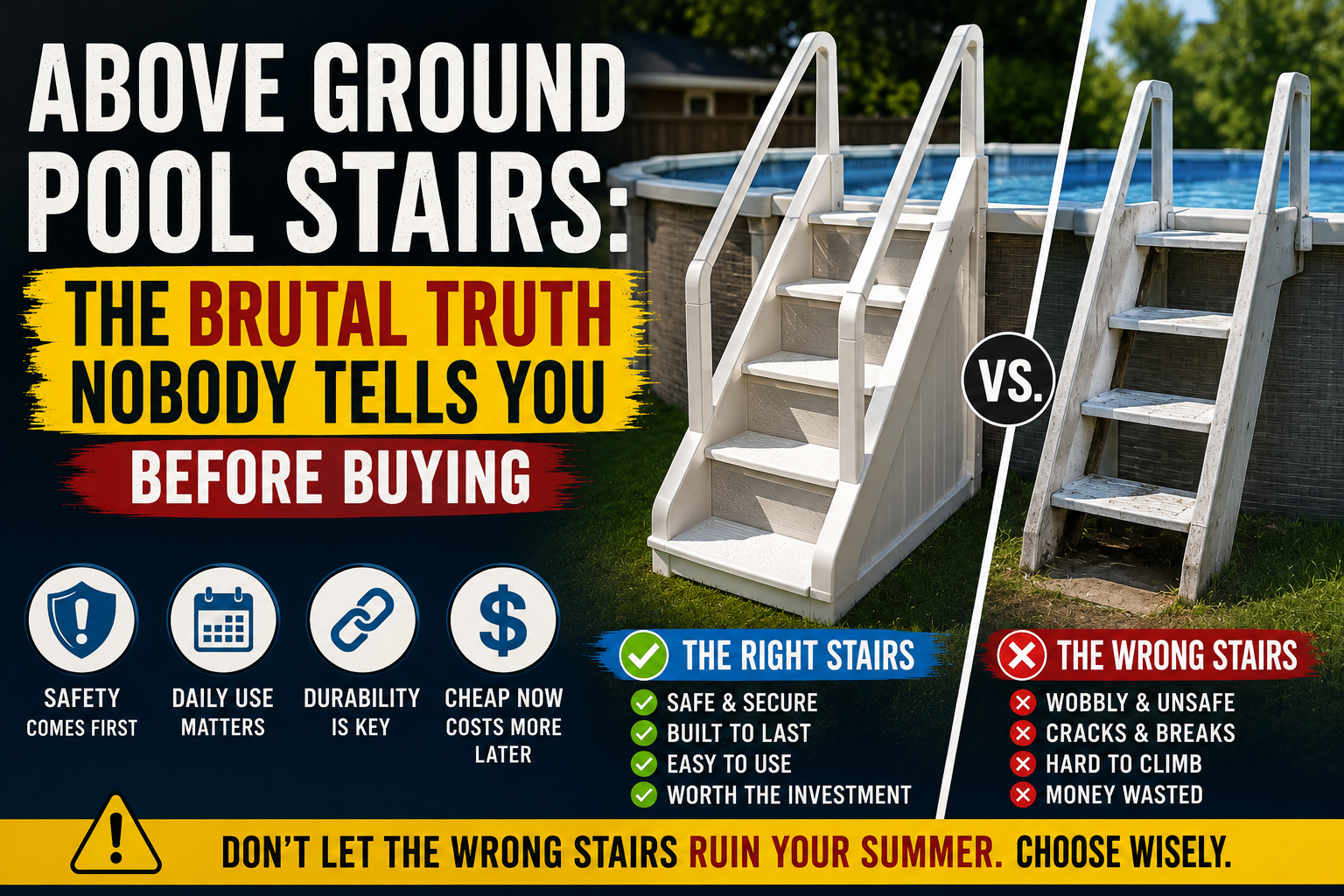
Let me save you a few hundred bucks and a sprained ankle. Most people pick above ground pool stairs the same way they pick a phone charger at the gas station, grab whatever’s cheap, hope it works, and curse later when it fails. I’ve watched plenty of pool owners go through three sets in two seasons because they bought based on price and looks instead of how the thing actually performs in real life.
Above ground pool stairs are not all built the same. Some flex like a wet noodle the second a full-grown adult steps on them. Others rust within a year, trap algae like a science experiment, or float around like pool noodles every time someone cannonballs in. If you want stairs that actually last, you have to know what you’re looking at before the box hits your driveway.
This guide walks you through every type, the real-world pros and cons, weight ratings that matter, safety stuff most blogs skip, and the exact mistakes that turn a good pool into a daily headache.
Why Above Ground Pool Stairs Matter More Than People Think
A pool ladder is fine if you’re young, fit, and don’t mind hauling yourself out of the water like you’re climbing out of a dumpster. Above ground pool stairs are different animals entirely. They give you actual steps, handrails, and a stable platform that doesn’t try to flip you backwards every time you climb.
Kids use them safely. Older relatives can get in without praying to the pool gods. Pregnant women, people with bad knees, anyone slightly buzzed at a summer party, they all benefit from real stairs versus a wobbly A-frame ladder.
There’s also the dirt factor. Stairs catch debris on the steps before it hits your pool floor. Ladders just dump everything straight in. Small thing, but you’ll notice your skimmer working less when you have decent stairs.
The Main Types of Above Ground Pool Stairs
Before you buy anything, know what you’re choosing between. Each type has a personality, and one of them is going to fit your setup better than the rest.
1. In-Pool Drop-In Stairs
These sit inside the pool and rest on the bottom. You climb up from the water, step onto a deck or pool wall, and you’re out. They’re stable, wide, and feel close to walking up regular house stairs.
The catch: they take up real estate inside your pool. If you have a 15-foot round pool, a big in-pool unit eats a noticeable chunk of swimming space. They also need to be weighted down with sand or water ballast, or they float. Yes, float. Nothing kills the vibe like watching your stairs bob away during a pool party.
2. A-Frame Ladder Style Stairs
The classic. Steps on both sides, one in the pool, one outside. Easy to install, easy to remove for winter, and usually the cheapest entry point.
They work, but they’re not luxurious. Steps are narrow, handrails can feel flimsy on cheap models, and stepping over the top rail is awkward for short people, big people, and anyone who’s had a few drinks.
3. Deck-Mounted Stairs
If you’ve built a deck around your pool, deck-mounted stairs are the upgrade everyone eventually wants. They attach to the deck on one side and drop straight into the water. No A-frame to climb over. No floating issue. Just walk down like you’re entering a hot tub.
They cost more, they require a deck, and installation is involved, but they look clean and feel premium.
4. Wedding Cake and Roman Style Stairs
Big tiered stairs that look like the bottom layer of a wedding cake, hence the name. Roman style is similar but flatter and wider. These are the most spacious option, often big enough to sit on with a drink in hand.
Downside: they’re heavy, expensive, and take up the most space inside the pool. But if your pool is your hangout zone, these turn your shallow end into a built-in lounge.
5. Heavy-Duty Stairs for Big and Tall Users
Standard pool stairs are usually rated for around 300 pounds. If you’re over that, or you have multiple adults piling on at once, you need heavy-duty rated stairs. Some models go up to 400 or 500 pounds and use reinforced resin or stainless steel frames.
Skip this and you’ll feel the flex on every step. Worst case, the stairs crack right when someone’s halfway up. Not a fun day.
The Materials That Actually Hold Up
Material is where most cheap stairs fail. Sun, chlorine, saltwater, and constant temperature changes destroy anything that isn’t built for it.
Resin and Heavy Plastic
The most common material. Good resin stairs last years, won’t rust, and handle UV beating without fading too fast. Bad resin gets brittle by season two and snaps when you least expect it. Look for UV-stabilized resin specifically.
Stainless Steel
Usually the frame, not the steps themselves. Marine-grade 304 stainless is fine for chlorine pools. For saltwater, you want 316 stainless or you’ll see rust spots within a year, no matter what the box claims.
Aluminum
Lightweight, easy to handle, but cheaper aluminum reacts badly with saltwater and aggressive pool chemistry. Decent for chlorine pools, risky for salt systems unless it’s specifically rated.
Weight Capacity: The Number Everyone Ignores
Read the weight rating. Then read it again. Most above ground pool stairs are rated for one person at a time, not three kids stampeding up together. That 300-pound rating is for a single static user, not dynamic load with people jumping or pushing off.
If you regularly have multiple people climbing at once, get something rated higher than your worst-case scenario. Stairs that fail are not the kind of surprise you want on a Saturday afternoon with a yard full of guests.
Safety Features Worth Paying Extra For
Cheap stairs skip safety. Good stairs build it in. Here’s what actually matters when someone’s wet, half-blind from sunscreen, and stepping onto a slick surface.
1. Non-Slip Step Surfaces
Textured steps are not optional. Smooth plastic gets slippery the second water hits it. Look for stairs with raised tread patterns or rubberized inserts.
2. Double Handrails
One handrail is okay. Two is better. Especially for kids and older swimmers, having something to grip on both sides changes the whole experience.
3. Lockable Outside Gate or Removable Outer Steps
This one’s a legal issue in some states. If you have kids around, the outside steps need to be removable or lockable so children can’t climb up when nobody’s watching. Some local codes require it.
4. Anti-Entrapment Step Design
Older designs had gaps between steps that could trap small fingers, hair, or swimsuit ties. Modern above ground pool stairs use closed-back or barrier designs to prevent this. Check before you buy, especially for older used models.
5. Built-In Drainage
Steps with drainage holes don’t trap stagnant water that breeds bacteria and algae. Sounds minor, but stagnant water on stairs gets nasty fast in summer heat.
Mistakes People Make Buying Above Ground Pool Stairs
Some lessons cost money. Here are the ones you don’t have to learn the hard way.
Buying Based on Price Alone
A 100-dollar set of stairs that fails after one season costs more than a 300-dollar set that lasts five. Cheap pool gear is almost always false economy. Spend once, cry once.
Ignoring the Pool Wall Height
Above ground pools come in different heights, usually 48, 52, or 54 inches. Your stairs have to match. A-frame stairs designed for a 48-inch wall will be too short for a 54-inch pool, and the climb over the top becomes dangerous.
Skipping the Sand Ballast
In-pool stairs need weight inside them to stay put. Most people fill them halfway, or not at all, then wonder why the stairs drift sideways. Fill them properly with sand or water as the manufacturer specifies.
Not Checking Liner Compatibility
Some heavy stairs put serious pressure on the pool liner where they sit. Cheap liners can tear under that load. Use a step pad or step mat underneath. It’s a 20-dollar accessory that prevents a 600-dollar liner replacement.
Forgetting Winter Storage
Resin and plastic crack in freezing temperatures if left in a frozen pool. Either get stairs designed to overwinter in the water, or plan to pull them out every fall. Many people don’t think about this until November.
How to Install Above Ground Pool Stairs Without Wrecking Your Liner
Installation isn’t complicated, but rushing it leads to problems that show up weeks later.
Start by laying a step pad on the pool floor where the stairs will sit. This protects the liner from punctures and weight points. Lower the stairs in slowly, don’t drop them. Position them flush against the pool wall, with no gap.
Fill the ballast chambers completely. Sand is more permanent, water is easier if you ever need to move them. Check that the top of the stairs sits at the right height relative to your pool wall, not too high, not too low.
For deck-mounted stairs, bolt them into solid framing, not just decking boards. Test the stability before anyone climbs on, push, pull, and bounce the structure to make sure nothing flexes.
Maintenance That Keeps Your Stairs Looking New
Pool stairs collect biofilm, calcium scale, and just plain gunk faster than the rest of the pool. A quick brush every week with a soft pool brush keeps them looking clean.
Once a month, lift them out if possible and hose down the undersides. The hidden surfaces grow algae you’d never notice from above. For tough scale, a mix of pool-safe descaler and a non-abrasive sponge works without scratching the resin.
Check handrail connections every few weeks. Bolts loosen over time, and a wobbly handrail is the kind of thing that fails right when someone leans on it hard.
What Above Ground Pool Stairs Actually Cost
You can find basic A-frame ladder stairs for around 100 to 200 dollars. Mid-range in-pool stairs run 250 to 500. Premium wedding cake or deck-mounted stairs hit 600 to 1200, and heavy-duty rated systems for bigger users can push past 1500.
If you’re using your pool weekly all summer, the math favors spending more upfront. Stairs that get used hundreds of times per season need to be built for that punishment.
Final Thoughts: Pick Stairs Like You Mean It
Your above ground pool stairs are the most touched piece of equipment in your entire setup. Every person who uses your pool uses the stairs. Every single time. They take more wear than the liner, the pump, or anything else, and they’re the difference between a pool that’s a joy to use and a pool that becomes a chore.
Buy the right type for your pool height, your users, and your space. Pay attention to materials, weight ratings, and safety features. Install them right and maintain them like they matter, because they do.
Get this one piece right and your pool stops being something you struggle to climb into, and starts being the spot everyone fights to hang out at all summer long. That’s worth doing it properly the first time.