
So let’s cut through the marketing fluff and talk about what actually works, what’s a waste of money, and how to pick a setup that keeps your water crystal clear without turning pool ownership into a second job.
What An Above Ground Pool Filter Actually Does
Your filter is the kidney of your pool. The pump moves the water, but the filter is what catches the dirt, sunscreen residue, dead bugs, pollen, hair, and all the other garbage that ends up in the water when people swim. Chemicals kill the bacteria. The filter physically removes the particles.
If your filter is too small for your pool volume, or if the media inside it is shot, no amount of chlorine will save you. You’ll just be chasing cloudy water all summer.
The rule of thumb most pros follow: your filter and pump should be able to turn over your entire pool volume in 8 hours or less. If you have a 10,000 gallon pool, you need a system pushing at least 1,250 gallons per hour through proper filtration. Most stock setups barely hit that, and they choke the second the water gets a little dirty.
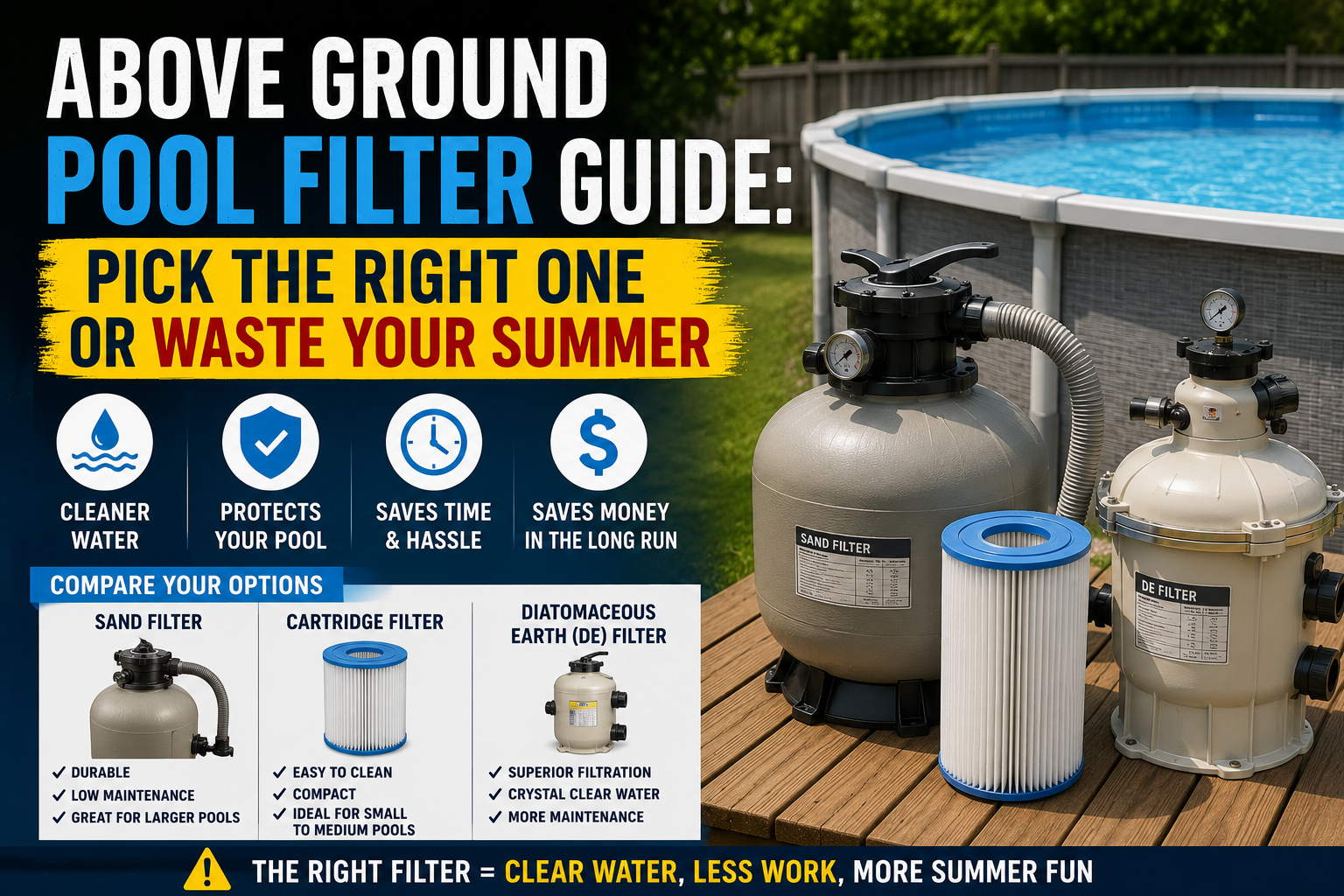
The Three Main Types Of Above Ground Pool Filters
There are basically three real options on the market. Each has trade-offs, and the right choice depends on your budget, how much maintenance you’re willing to do, and how clean you actually want the water.
1. Sand Filters
Sand filters are the workhorses. You fill a tank with #20 silica sand or a glass media alternative, water gets forced through it, and the dirt sticks in the sand bed. When it gets dirty, you flip a valve and backwash it, which flushes the crap out to waste.
Filtration level is around 20 to 40 microns, which is fine for most backyard pools. Sand is the easiest filter to live with because you’re not constantly pulling out cartridges or messing with powder. You replace the sand maybe every 5 to 7 years and that’s it.
Downside: it’s the least fine filtration of the three. If you have ultra fine debris or you’re obsessive about glass clear water, sand alone won’t get you there without a clarifier.
2. Cartridge Filters
Cartridge filters use a pleated paper or polyester element, kind of like a giant car air filter. Water passes through the pleats and the dirt gets trapped on the surface. When pressure builds up, you pull the cartridge out, hose it down, and put it back in.
Filtration is finer, around 10 to 20 microns, so your water will look noticeably cleaner than with sand. No backwashing means you’re not wasting hundreds of gallons of treated water every week, which matters if you’re on a well or in a drought area.
Downside: hosing off a filthy cartridge in the summer heat is not anyone’s idea of a good time, and you’ll need to replace the element every 1 to 3 seasons depending on use.
3. DE (Diatomaceous Earth) Filters
DE filters are the gold standard. They use grids coated in a fine powder made from fossilized algae. Filtration goes down to 2 to 5 microns, which is finer than what’s used in some drinking water systems.
Your water will look like you could drink it. Nothing else gets water this clear, full stop.
Downside: they’re the most expensive to buy, the most fiddly to maintain, and you have to recharge the DE powder after every backwash. They’re overkill for most above ground pools, but if you want showroom water, this is how you get it.
How To Size An Above Ground Pool Filter Correctly
This is where most people screw up. They look at the price tag, grab the cheapest unit that says “fits up to 24 foot pool” on the box, and wonder why their water turns green by August.
Sizing comes down to two numbers: gallons per minute (GPM) of flow rate, and square feet of filtration area. Always buy a filter rated for a bigger pool than you actually have. If you have an 18 foot round, get a system rated for a 24 foot. If you have a 24 foot, get one rated for a 30 foot.
Why? Because the manufacturer ratings assume perfect conditions, brand new media, and minimal bather load. Real world performance is always worse than the box claims.
Quick Sizing Reference By Pool Size
- 12 to 15 foot round pools: Look for at least 12 inch sand filter tanks or 50 sq ft cartridge filters with a 1 HP pump pushing 35+ GPM
- 18 foot round pools: 16 inch sand tank or 75 sq ft cartridge, paired with a 1 to 1.5 HP pump at 45+ GPM
- 21 to 24 foot round pools: 19 inch sand tank or 100 sq ft cartridge, 1.5 HP pump minimum, 55+ GPM
- 27 to 30 foot round or large oval pools: 22 inch+ sand tank or 150 sq ft cartridge, 2 HP pump, 70+ GPM
- Any pool with heavy use, kids, or trees nearby: Bump up one size from the standard recommendation
The Most Common Above Ground Pool Filter Mistakes
I see the same handful of mistakes over and over. Avoid these and you’ll save yourself a lot of cursing.
Running The Pump Too Little
Most people run their pump 4 to 6 hours a day to save on electricity. That’s not enough. You need at least 8 hours, ideally 10 to 12 during peak summer. Your filter can’t filter water that isn’t moving through it.
Skipping The Pre-Filter Skimmer Sock
A $5 mesh sock in your skimmer basket catches 80% of the hair, leaves, and grit before it ever reaches your filter. This one cheap trick will double the life of your sand or cartridge.
Backwashing Too Often
A dirty sand filter actually filters better than a freshly backwashed one, up to a point. The trapped debris helps catch finer particles. Don’t backwash until the pressure gauge reads 8 to 10 PSI above the clean baseline.
Ignoring The Pressure Gauge
That little gauge on top of your filter is the single most important diagnostic tool you have. Know your clean pressure. Watch it climb. When it’s time to clean, clean. When it spikes for no reason, something is wrong.
Cheap Replacement Cartridges
The off brand cartridges on Amazon look identical to the real ones. They are not the same. The paper is thinner, the end caps separate, and the seals leak. Buy the OEM cartridge or a reputable aftermarket brand like Unicel or Pleatco. The fake ones will cost you more in cloudy water than you saved.
Maintenance Schedule That Actually Works
Here’s the no-bullshit maintenance routine that keeps any above ground pool filter running at peak performance without taking over your life.
Daily (30 Seconds)
- Glance at the pressure gauge
- Make sure the pump is primed and running quietly
- Empty the skimmer basket if it’s full
Weekly (10 Minutes)
- Empty the pump basket completely
- Brush the pool walls so debris ends up in the filter
- Check skimmer sock and replace if loaded
- Test water chemistry, balanced water makes the filter’s job easier
Monthly (30 Minutes)
- Deep clean cartridges with a filter cleaner soak, or backwash sand filter until water runs clear
- Inspect O-rings and lubricate with silicone grease
- Check for leaks around the multiport valve or filter tank
End Of Season (1 Hour)
- Acid wash or deep soak cartridges before storage
- Drain the filter tank completely so it doesn’t freeze and crack
- Store cartridges dry in a sealed bag
- Cover the pump and filter or bring them inside if possible
When To Upgrade Your Filter
If you’re constantly fighting cloudy water, if your pump cycles on overload, if you’re cleaning the cartridge every three days, it’s time. Don’t keep throwing chemicals at a problem the filter is causing.
A proper upgrade for a mid sized above ground pool runs $300 to $600 for a quality sand or cartridge system. That sounds like a lot until you realize you’re spending $40 a week on shock and clarifier trying to compensate for a weak filter. The upgrade pays for itself in one summer, sometimes faster.
Look at brands like Hayward, Pentair, Intex (their better models, not the entry level), and Waterway. Avoid no-name systems from Amazon that don’t have a US parts and service network. When something breaks in year two, you want to be able to actually get a replacement O-ring without ordering it from overseas.
Sand Vs Cartridge Vs DE: My Honest Take
If you want the easiest life and clean enough water, get a sand filter. Throw in some glass media instead of regular sand for a small upgrade in filtration. Done.
If you have a smaller pool, want finer filtration, and don’t mind hosing things down once in a while, go cartridge. They’re efficient, they save water, and the filtration is genuinely better.
If you’re a perfectionist with a budget and you want water so clear it disappears, DE is the answer. Just know what you’re signing up for.
There’s no wrong answer, only the wrong filter for your situation. Match the system to your pool, your time, and your standards.
Final Thoughts
A good above ground pool filter is the difference between actually enjoying your pool and resenting it. The pool itself is just a hole full of water. The filter is what turns it into something you actually want to swim in.
Don’t cheap out, don’t undersize it, and don’t trust the box rating. Buy a step up from what you think you need, run your pump long enough every day, stay on top of the basic maintenance, and the rest takes care of itself.
Your summer is too short to spend it staring at green water. Get the filter right, and you’ll spend the rest of the season actually using the damn pool.