
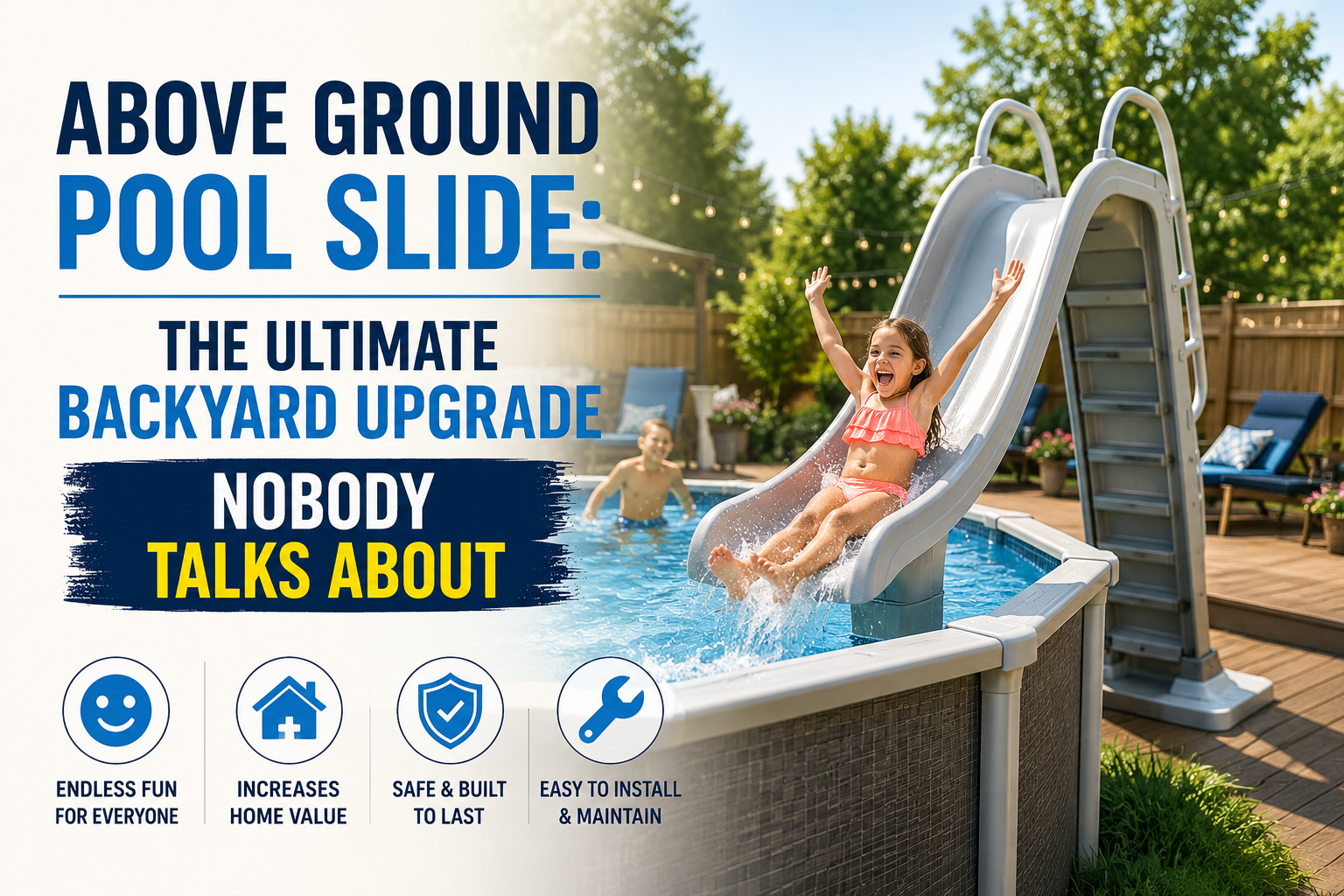
No fluff. No affiliate spam. Just real talk about what slides hold up, what falls apart, and how to install one without cracking your liner or your skull.
Why an Above Ground Pool Slide Actually Changes Everything
Here’s the truth nobody mentions. An above ground pool is fun for about two weeks. Then the kids get bored. They float, they splash, they get out. Adding a slide instantly doubles the time anyone spends in that water.
It’s not just for kids either. I’ve had grown adults at backyard parties line up like it was Six Flags. There’s something about going down a slide into water that resets your brain to age eight, no matter how old you are.
The other thing? It makes your pool look like an actual destination. A plain round pool sitting in the yard looks like a stock tank. Add a slide and suddenly it’s a backyard waterpark. Property value, party invites, neighbor envy. All of it goes up.
The Real Problem With Most Above Ground Pool Slides
Most slides on the market are built for in-ground pools. That’s the dirty secret. They assume you have a concrete deck, anchor points, and a pool wall that doesn’t flex.
An above ground setup is a different animal. Your wall is thin steel or resin. Your deck, if you have one, is wood or composite. The slide has to be supported entirely on its own legs or bolted into a deck that can take the load.
This is where people screw up. They buy a heavy fiberglass slide meant for in-ground use, try to lean it against the pool wall, and bend the top rail. Or they bolt something into a deck board that was never rated for 250 pounds of dynamic load. Bad things follow.
Height Matching Is the First Thing Most People Get Wrong
Standard above ground pools are 48 to 54 inches tall. Your slide’s exit point, the lip where you launch off, needs to sit just above the waterline. Not two feet above it. Not below it. Just above.
If the exit is too high, you slam into the water hard enough to bruise your tailbone. Too low and you scrape against the pool wall on the way in. Both are ways to ruin an afternoon and possibly your spine.
The Five Types of Above Ground Pool Slides Worth Considering
Not all slides are created equal. After going through several myself and watching friends do the same, here’s the honest breakdown of what’s actually out there.
1. Deck Mounted Fiberglass Slides
These bolt directly into a wood or composite deck that surrounds the pool. They’re the gold standard if you have a real deck. Sturdy, smooth, and they last decades if you keep them out of constant UV.
The catch is they’re expensive and heavy. You’re looking at five hundred to over two thousand dollars, plus the deck has to be rated to hold the slide and the rider’s weight combined. Not a casual purchase.
2. Freestanding Resin Slides
These are the most popular option for above ground pool owners who don’t have a full surround deck. They stand on their own legs, usually with a small platform or ladder built in. Models from companies like SR Smith and Intex dominate this category.
They’re lighter, cheaper, and easier to move at the end of the season. The downside is they wobble more under heavier riders, and you have to watch where the exit sits relative to your pool wall. Position matters enormously.
3. Inflatable Pool Slides
I’ll be blunt. Most inflatables are toys. They’re fine for kids under sixty pounds and they’re cheap, but they slip, slide around on grass, and almost never stay where you put them.
That said, there are a few heavy-duty commercial inflatables that are genuinely solid. If you go this route, look for ones with water ballast pockets and anchor straps. Skip anything that costs less than a tank of gas.
4. Pool-Edge Cushion Slides
These are short, soft slides that hook directly onto the top rail of the pool. They’re designed for small kids and they’re the safest option for toddlers learning to swim. Foam construction, no hard edges, no real height.
The trade-off is obvious. They’re not exciting. A nine year old will use it twice and walk away. But for the three-to-six crowd, they’re perfect.
5. DIY Custom Builds
If you’re handy and patient, you can build a custom slide platform out of pressure treated lumber and mount a fiberglass slide section to it. I’ve seen some beautiful builds online, with stairs, handrails, even integrated planters.
The risk is real though. A poorly built platform can collapse, and a fall from five feet onto the pool’s metal top rail is not something you walk off. If you go DIY, overbuild it. Then overbuild it again.
How to Actually Install an Above Ground Pool Slide Without Destroying Your Pool
Installation is where dreams die. Let me walk you through what actually matters.
Check Your Pool Wall First
Walk around your entire pool and look for any bulges, rust spots, or flex in the wall. If the wall is already compromised, do not, under any circumstances, mount anything to it. A failing wall plus added stress equals a flood in your backyard. I’ve watched it happen.
Position the Slide for Water Depth
The exit point of your slide needs at least 36 inches of water below it. Most above ground pools have a flat bottom, so this is easy. But if you have a hopper or any kind of slope, position the slide over the deep section.
Anchor Properly or Don’t Anchor at All
If your slide came with anchor bolts and your deck is rated for it, use them exactly as specified. If you’re freestanding, level the ground underneath the slide legs with paver stones. Don’t just set it on grass and call it done. Grass shifts, slides tip, riders fly.
Test With Weight Before Letting Anyone Ride
This is the step everyone skips. Once installed, push and pull on the slide with all your weight in every direction. If it moves more than a quarter inch, something is wrong. Find it before someone heavier than you finds out the hard way.
Safety Rules That Actually Matter
Pool slide injuries are real and most are preventable. The rules below aren’t liability theater, they’re things I’ve seen go wrong in real backyards.
- No headfirst sliding, ever. Above ground pools are too shallow. Going in headfirst is how necks break.
- One rider at a time, no exceptions. Two kids tangling on a slide is how teeth get knocked out.
- Wet the slide surface before every use. Dry plastic creates friction burns and unpredictable stops.
- Keep the bottom of the pool clear of toys, floats, and especially other swimmers when someone is sliding.
- No drinking adults on the slide. I shouldn’t have to say it but here we are.
What to Look for When Buying Your First Above Ground Pool Slide
If you’re walking into this fresh, here’s the short list of specs that actually matter.
- Weight capacity rating that exceeds your heaviest expected rider by at least fifty pounds.
- UV-stabilized resin or fiberglass construction, not basic polyethylene that yellows and cracks in two seasons.
- A flume width of at least sixteen inches so adults can actually fit comfortably.
- Non-slip steps with handrails on both sides. Wet feet plus narrow steps equals broken collarbones.
- A water spray feature or hose connection that keeps the surface slick during use.
The Best Above Ground Pool Slide Brands Right Now
I’m not going to pretend there are fifty great options. There aren’t. Here’s what’s actually worth your money in 2026.
SR Smith Heritage
The benchmark. Built for in-ground but adaptable to above ground setups with a solid deck. Lifetime construction, smooth ride, looks like something from a real waterpark. Expensive but you buy it once.
Intex Inflatable Play Center
For families with small kids and a tight budget. Decent quality for an inflatable, integrates with their pools, and won’t financially ruin you if a tree branch falls on it.
Vortex Pool Slide
A mid-range freestanding option that gets the geometry right for above ground pools. Resin construction, reasonable price, decent height. Not the prettiest but it does the job.
Common Above Ground Pool Slide Questions
Can I put any slide on any above ground pool?
No. Match the slide’s exit height to your pool wall height, and confirm the slide isn’t designed to lean on or hook into the pool itself unless yours has reinforced rails rated for it.
How much does a decent above ground pool slide cost?
Real ones start around 400 dollars for freestanding resin models and climb past 2000 for premium fiberglass setups. Anything under 200 is either a toy or a hazard.
Do I need a permit?
Usually not for a slide itself, but check your local code if you’re building a deck to support it. Some municipalities have fence and barrier rules that come into play once your pool area gets more permanent features.
Will adding a slide void my pool warranty?
Possibly, if you bolt anything into the pool wall. Freestanding slides that don’t touch the pool structure are almost always fine. Read your warranty before drilling anything.
Final Thoughts From Someone Who’s Been There
Adding an above ground pool slide is one of those upgrades that sounds simple and turns out to have layers. Get the height right, pick a model built for your setup, install it on stable ground, and enforce a few basic safety rules. Do that and you’ve got an addition that pays for itself in pure joy every single weekend of the summer.
Skip the cheap stuff. Skip the shortcuts. Buy once, install carefully, and you’ll be the house every kid in the neighborhood wants to visit. And honestly, you’ll catch yourself sneaking out for a few runs after the kids go to bed too. No shame in that. That’s exactly the point.
Now go measure your pool wall, check your deck, and start shopping. Summer waits for no one.